HST – Half Square Triangle Quilt Tutorial

HST – Half Square Triangle Quilt – the one I always wanted to make and never started. This easy pattern is ideal for practicing precise cutting, piecing and pressing. Since I was working with the wonderful batiks on my last project and liked them very much,  I decided to carry on with the same fabrics. They are so colourful and warm.

Quilt size : 42″ x 48 “

Distribution : 16 rows with each 14 HST blocks, all together 224 HST blocks.  I have decided to work with 4″ strips. After piecing and trimming the blocks have a size of 3,5″ x 3,5″.

Material :

Solid fabric : 1 1/2 yard from colour of your choice; cut in 4″ strips and then in 4″ x 4″ squares

Colour fabrics : all together 1 1/2 yard or 13 different colours; cut in 4″ strips and then in 4″ x 4″ squares

Backing fabric : 1 1/2 yard

Batting : 43″ x 50 ”

Binding : 3/8 yard, cut 5 strips each 2,5″

Assembly :

1. Prepare all pieces by cutting into squares

2. Draw a diagonal line on the left side of the solid fabric, pin together with a batik one

3. Sew all squares along the drawn line with a 1/4″ seam allowance (normally width of the presser foot) using the chain piece method.

4. Complete the piecing by sewing along the other side of the line.

5. Now cut the squares diagonal along the drawn line in

6. Press seams open

7. Trim the squares to 3,5″ x 3,5″

8. You are ready to work on the layout. Using a design wall you can distribute the colour squares according your imagination – see below

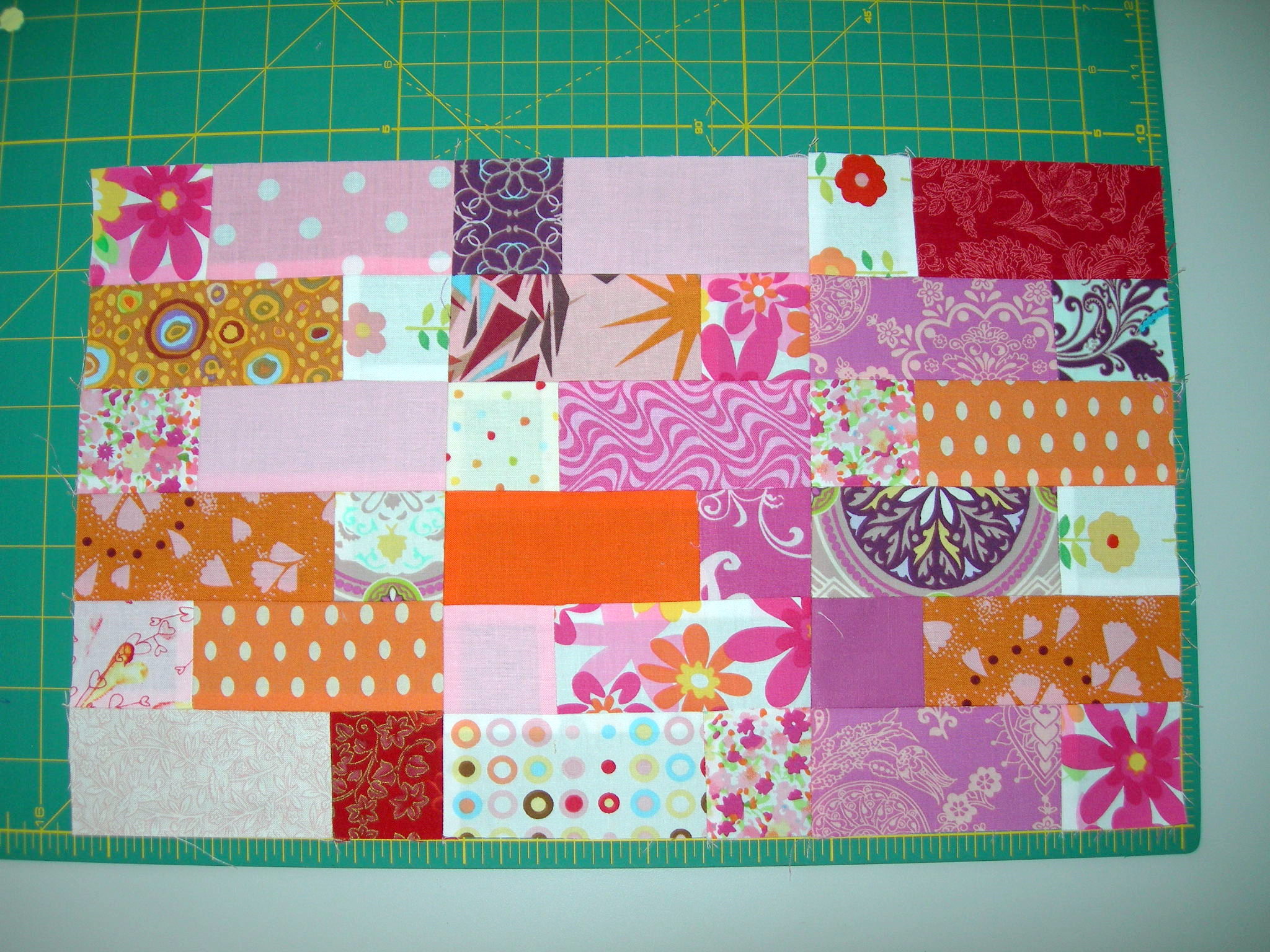
I have decided to subdivide the quilt into several sewing batches. Taking always 4 rows with 7 squares. First I sew each row together, then the rows and as last the batches.

Here the rows are pressed a ready for pinning :

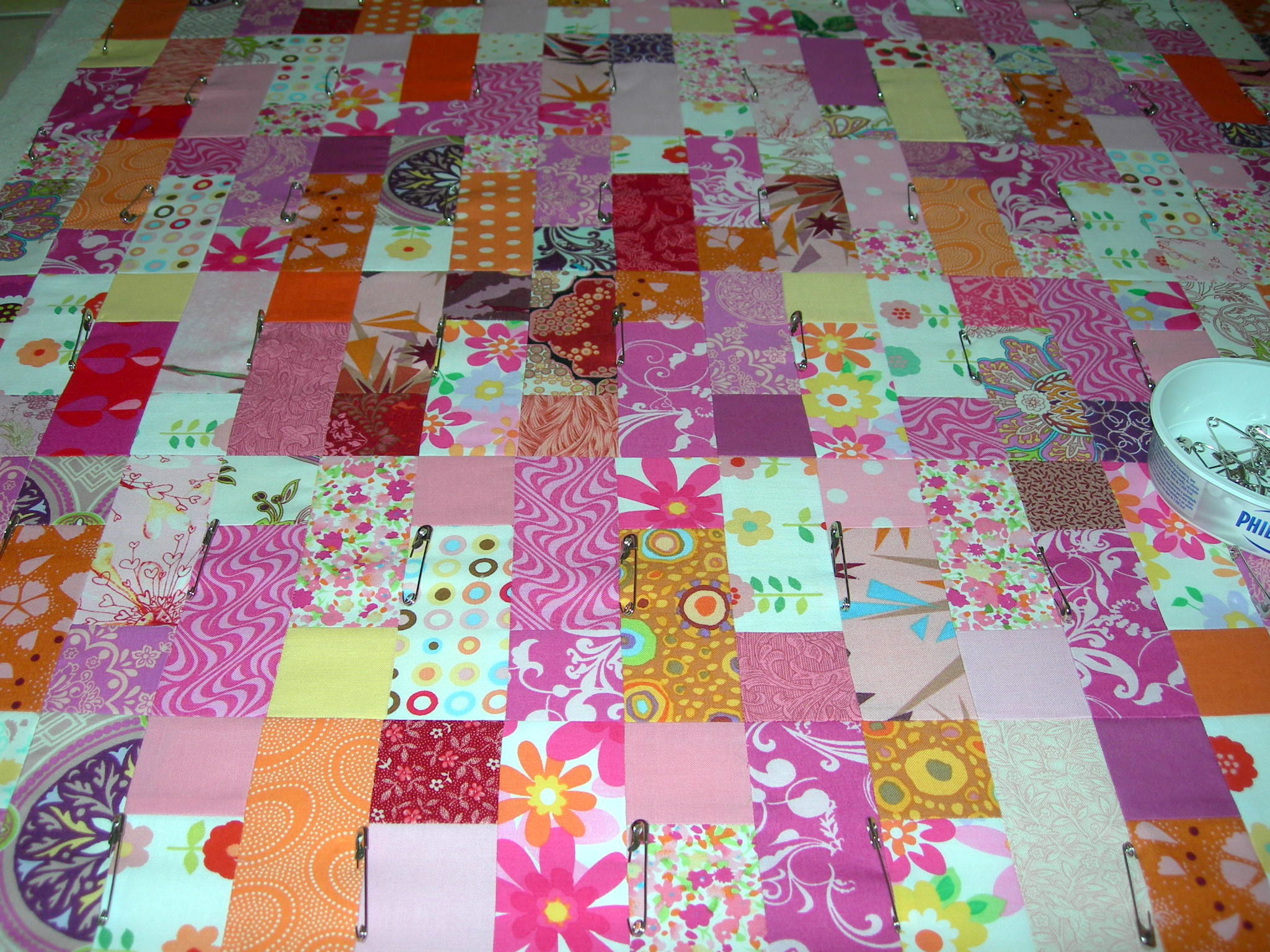
Accurate pinning is the secret to a nice and tidy quilt top. So take time, don’t hurry and work on your skills :

Once more : I pressed all seams open

And this is the finished top :

Prepare a sandwich and quilt as you want. After a lot of straight line quilting I decided to go for free-motion quilting. Trim the quilt and add binding. My favorite machine binding tutorial.

The quilt is listed on Etsy and Dawanda S O L D ! !

I’ve been listed in the Etsy Spring Lookbook 2012

Yesterday was my lucky day.

When I opened my emails in the morning there were 2 mails

  1. I’ve been listed in the Etsy Spring Lookbook 2012. please use this link to open the online version, my Etsy store Skala Bara is on page 74!
  2. I’ve been asked if I would be interested in participating in a project to help girls in Romania by sending a 8×8″ block. This is also something new for me and I looking forward to do it. Please find more information on this blog: www.callingallquilters.blogspot.com/

I’ve had also a check at the hospital and I am in total remission with my lymphoma. Thanks God, everything is OK 9 months after finishing with my chemo.

And last but not least – my hubby Helmut invited my for meal at our local Indian restaurant. And this means no cooking in the evening, hurrah, hurrah.

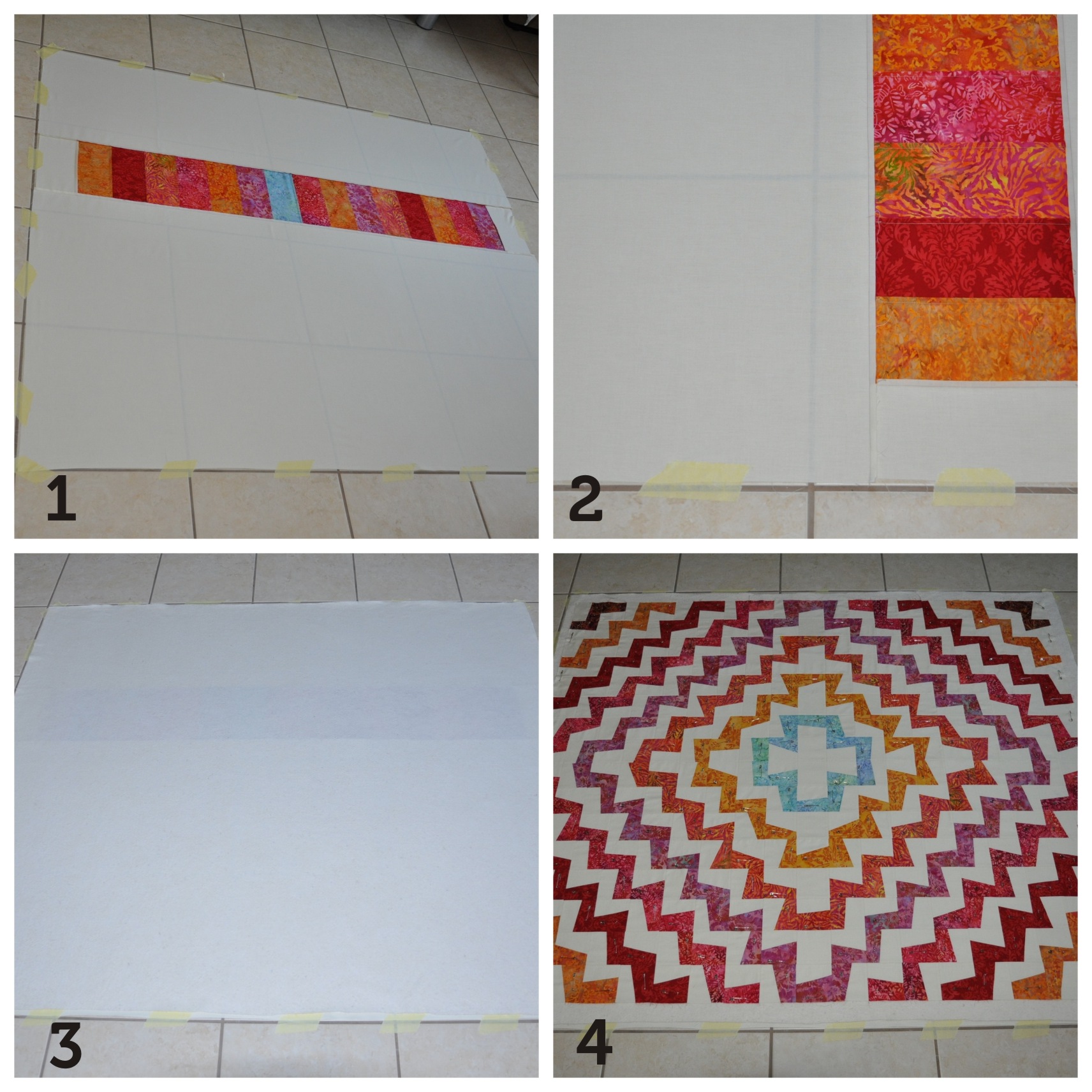
Here more info about the Rock Around the Clock Quilt or a quick tutorial how to make a sandwich:

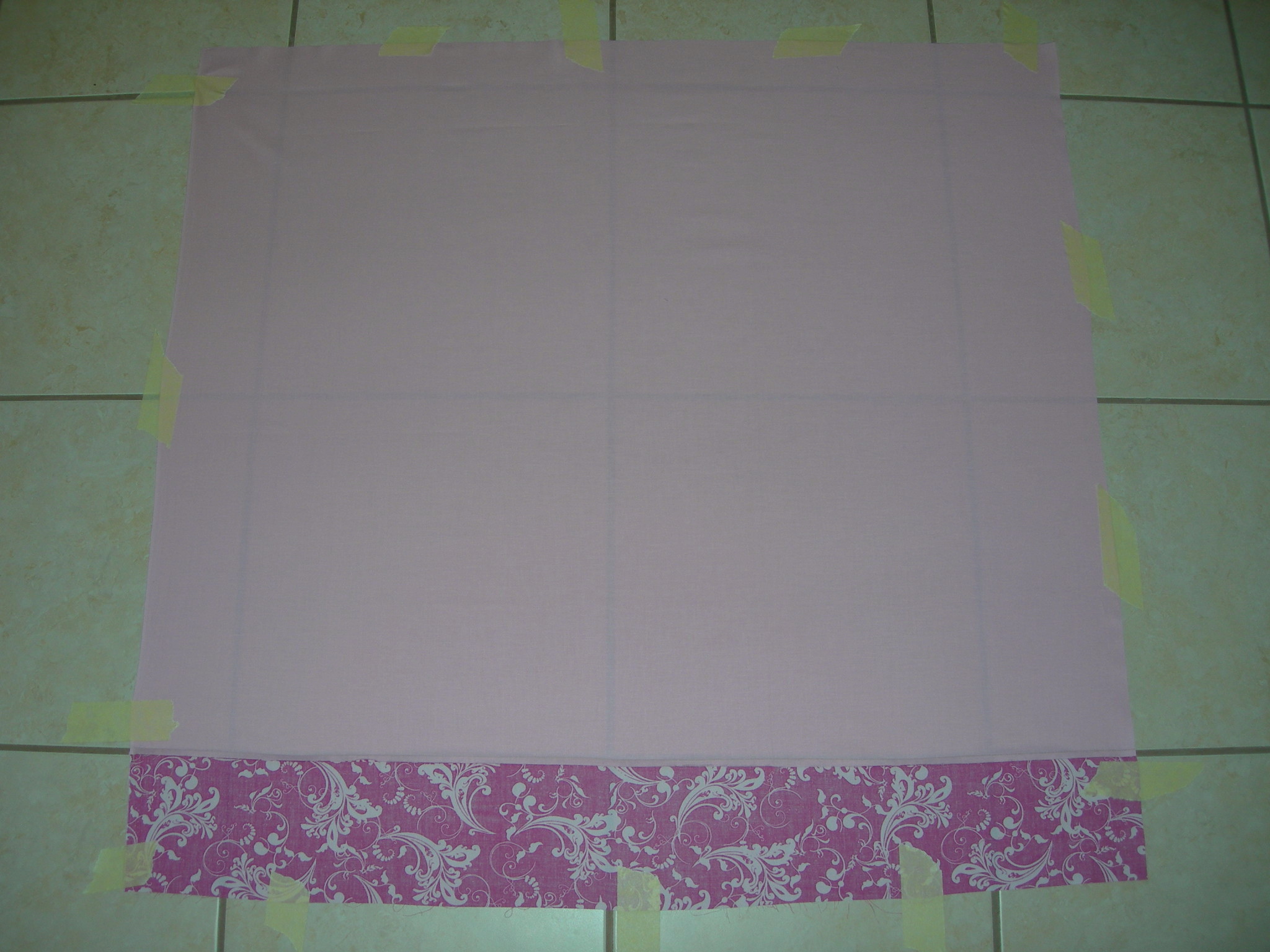
  1. Spread the backing right side down on the floor. Tape it firmly to the floor (using strips of painter’s tape), the fabric is completely smooth. Remember : both backing and batting should be approx. 1″ bigger on each side than the quilt top.
  2. Detail of taping. I use the tile grouts as orientation lines for positioning the quilt backing and top.
  3. Spread the batting on top of the backing and smooth out any wrinkles.
  4. Spread the (well ironed)  top on the batting. Starting from the centre smooth out any wrinkles. Watch the correct alignment of the backing and top. this is your last chance for correction before pinning. I use curved safety pins, start from the centre and pin carefully through all 3 layers (backing, batting, quilt top). Once you have pinned the entire sandwich remove the tape, fold the sandwich and you can start quilting!

At the moment I am thinking about the quilting style for this special top. Should I go for free-motion quilting (with less experience) or for straight lines with a walking foot? Since I have not decided yet, I started a new project with the same wonderful batik fabrics, it is a HST Quilt.

More info next time, happy sewing

Barbora

Tutorial : Oven Mitts Chilli Pepper

First of all I am happy to be back in Spain. We have sunshine and mild temperatures for this time of the year. And imagine, in 2 weeks time we are already in 2012.

Anyway, back to the tutorial. Photo of the finished oven mitts :

Pair of Oven Mitts Chilli Pepper

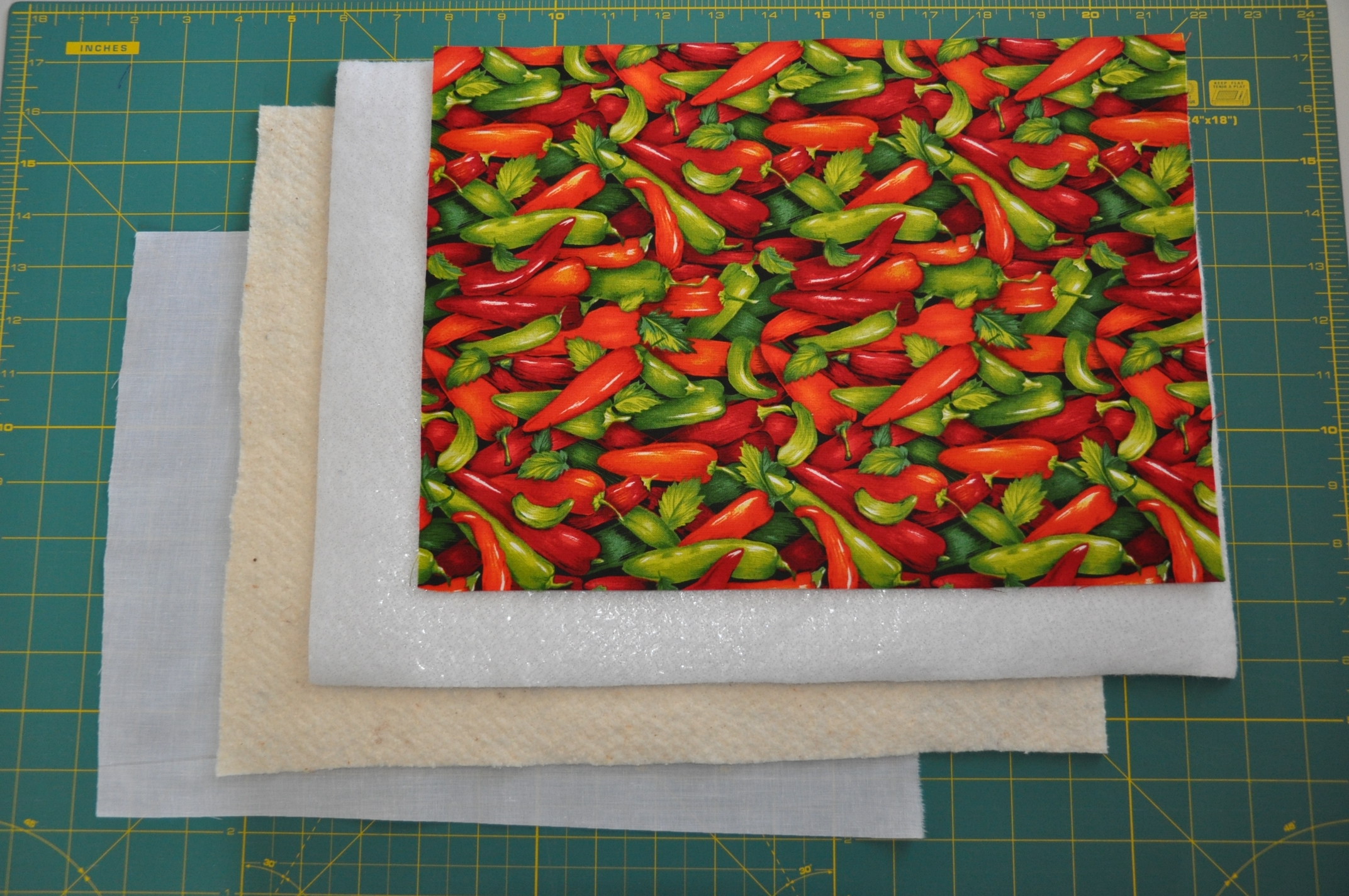
Materials  – quantity for a pair of oven mitts:

  • 4x pieces of  decoration fabric, size 9,5″ x 10″ (I have opted for solid orange and a chilli pepper pattern fabric)
  • 4x Insul-Bright from the Warm Company or any other heat-resistant batting, size 9,5″ x 10″
  • 4x 100% cotton batting, size 9,5″ x 10
  • 4x cotton muslin or other cotton fabric for backing, size 9,5″ x 10″
  • approx. 1 yard ½ inch (1.27 cm) double fold bias tape for binding and hanging loops
  • coordinating cotton thread for sewing and quilting

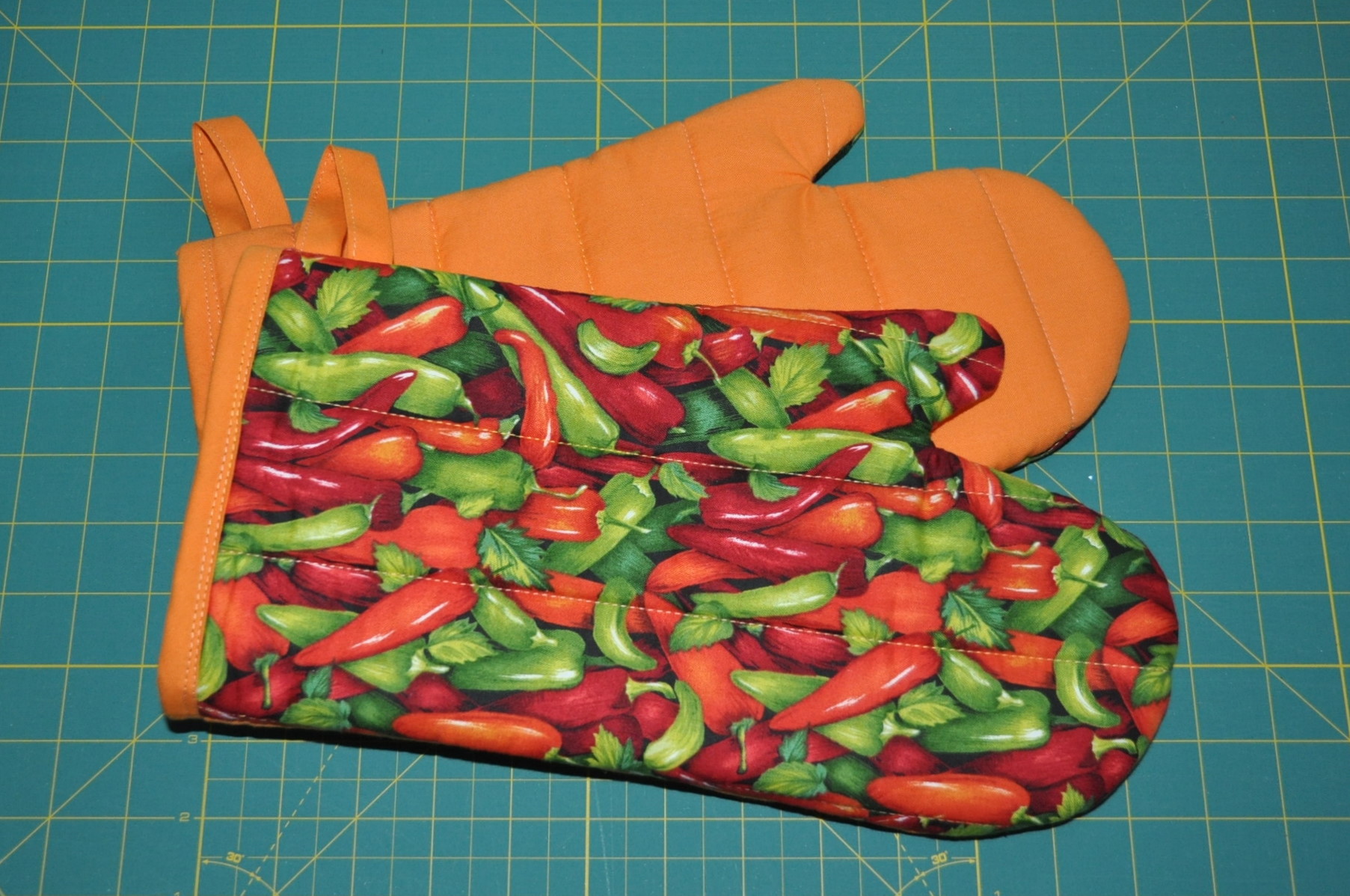
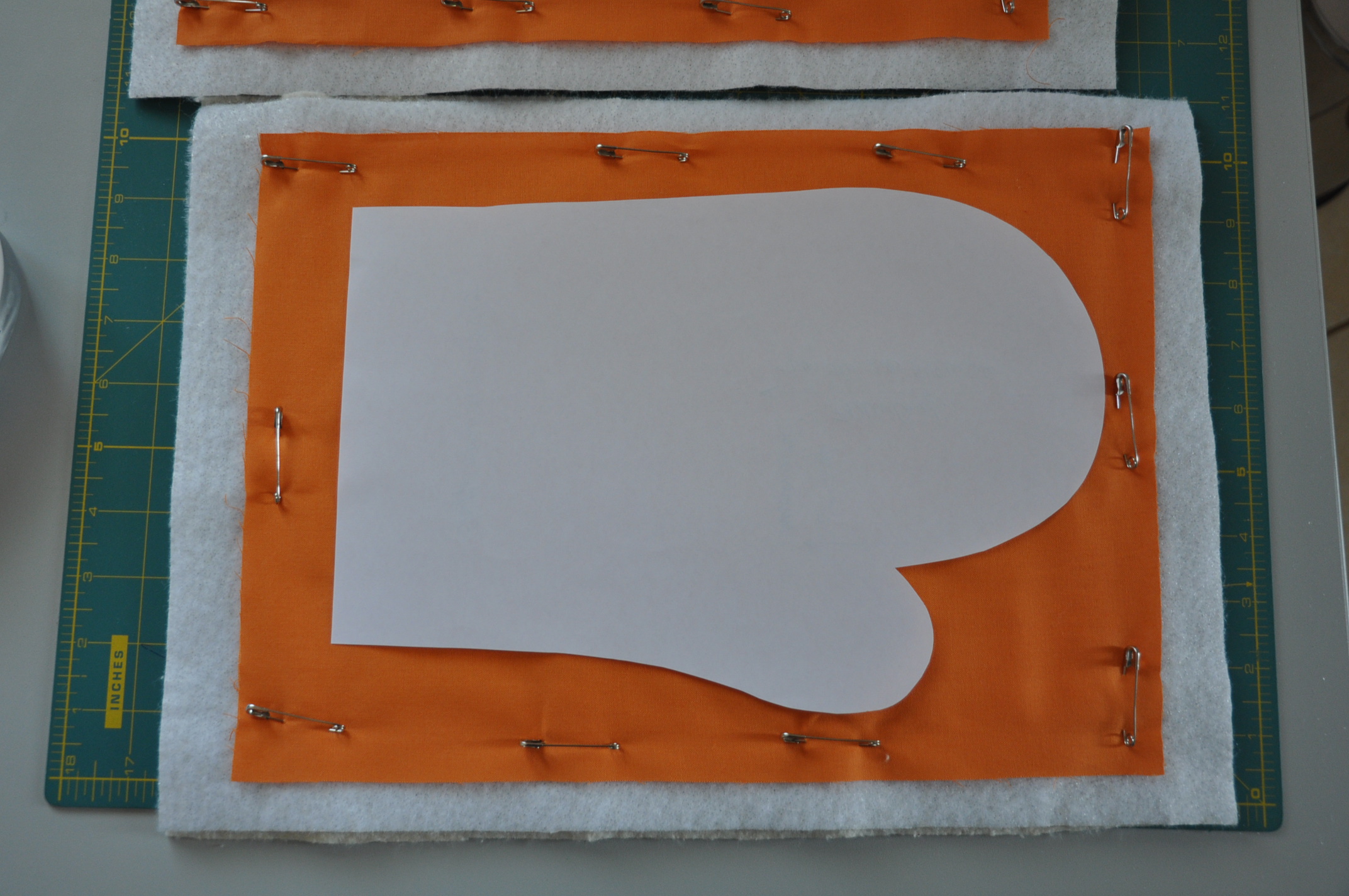
Oven mitt pattern – see the proximate size on the cutting board:

1

Press and cut all fabrics and batting.

Making a sandwich: place first the backing fabric, wrong side up. Next cotton batting, than heat-resistant batting (check instructions from producer, which side up), finally the decoration fabric.

2

Baste the layers together and choose color of the quilting thread :

3

Check once more the size and think about the quilting pattern.

4

I have opted for vertical (on the chilli fabric) and horizontal (orange) lines :

5

Square both sandwiches, orange and chilli fabric facing each other on the inside and mark the oven mitt pattern. Bast all layers together :

6

Sew around the marked line, on the thumb side leave approx. 4″ open (no seam yet), trim both mitts.

8

Now take the bias tape and start at the thumb side, where the seam is still open. Fold it and make with it a binding around the mitt. Forgot to make pics – silly me!!

Cut approx 6″ of the bias tape, fold and sew together to make a hanging loop. Pin the loop on the inside of the mitt and finish sewing the still open seam on the thumb side.

Turn around – you have made it !!

9

Nine Patch Block Variations Or Red Bird Baby Quilt

Quilt Design

Thinking about what could be my next project I saw some nice nine patch quilts on the internet. This inspired me not only to work with a classical nine patch block, but also with some variations. Nine patch blocks are easy to sew, versatile and so a right choice for beginners. With these blocks you can check (and practice) your exact fabric cutting, sewing skills and pressing. Chain piece using 1/4” seam allowance throughout the project.

You can always alternate the size according to your needs : divide the finished block size by three and add 0,5” seam allowance to each cut square.

Sit down and think about the finished quilt, which block type you fancy, what are your favorite colours. Make a drawing, use your color pencils and start cutting.

Fabric choice

I used my favorite colors orange, pink and turquoise. To complete the palette I decided to integrate also some purple hues.

Go for your favorite shades, use solids and don’t be afraid to use strong colors. You can opt for a patchwork fabric designer collection (with matched colours) or just use your stash.

Nine Patch Block Variations

Cutting diagram is for a finished block size 6” square

Block A
Cut 4        2,5” x 2,5”     Light Turquoise
Cut 2        2,5” x 2,5”     Orange
Cut 1        2,5” x 6,5”     Orange

Block B
Cut 4        2,5” x 2,5”     Dark Turquoise
Cut 4        2,5” x 2,5”     Pink
Cut 1        2,5” x 2,5”     Dark Purple

Block C (is basically a Log Cabin)
Cut 1        2,5” x 2,5”     Light Green
Cut 2        2,5” x 2,5”     Light Purple
Cut 2        2,5” x 6,5”     Light Purple

Block D
Cut 1        2,5” x 6,5”     Dark Turquoise
Cut 1        2,5” x 6,5”     Light Purple
Cut 1        2,5” x 6,5”     Yellow

Block E
Cut 1        2,5” x 6,5”     Light Purple
Cut 1        2,5” x 4,5”     Orange
Cut 1        2,5” x 4,5”     Light Turquoise
Cut 1        2,5” x2,5”      Yellow

Block F
Cut 1        2,5” x 4,5”     Dark Turquoise
Cut 1        2,5” x 2,5”     Dark Turquoise
Cut 1        2,5” x 4,5”     Light Green
Cut 1        2,5” x 2,5”     Light Green
Cut 3        2,5” x 2,5”     Orange

Calculation example for a finished block size 9” square
Cut all squares                     3,5” x 3,5”
Cut smaller rectangles     3,5” x 6,5”
Cut larger rectangles        3,5” x 9,5”

Assembly

Chain piece the units row by row together, press seams open. Pin the rows together, check that the seams match and piece, press seams open.
Check the block size : 6,5 x 6,5”, trim if needed.

Arrange the blocks randomly row by row. Use your design wall or distribute the blocks on the floor to overlook the quilt design. Rearrange pieces till you are happy with the colour distribution and sew together.

So this is it ………… finished quilt top. Now prepare the quilt sandwich, give the quilting pattern an other thought and you are nearly there.  Cut stripes for binding and your quilt is now finished!!

Why Red Bird? Wait for the next post, untill then Barbora

Pink Summer Garden Quilt Tutorial

My very first tutorial. This is a great new experience for me. I wanted to do it for some time but did not dare to do so. So, lets start :

Quilt design

Quilt size finished 32″ x 30 1/2″. This is a pattern for a baby quilt that mixes squares and rectangles.

Fabric choice

Check your scrap basket. Select the colors you like – for my quilt I looked for warm shades: pink/red/orange. In case you do not have enough fabric rests, some shops sell scrap bags in different colors.

Backing : 1 yard

Batting : 35″ x 36″

Binding : 10″ from favorite color fabric. Cut 4 stripes each 2 1/2″

Cutting

126 pieces size : 2″ x 2″

126 pieces size : 2″ x 4″

Cut carefully and precise so that you quilt lines up as desired.

Assembly

Sew each 2″ x 2″ square to a 2″ x 4″ rectangle using a 1/4″ seam allowance. Chain piecing is the right solution, this saves thread and avoids thread jamming. I always use a small piece of fabric to start sewing.

For piecing I use cotton thread from Superior Threads – Masterpiece 50/2 in a natural color. I think white thread is too bright and can gleam through the seams after pressing.

Make random pairs by mixing the different fabrics together. Press the seams towards the square. Using a ruler check the correct unit size : 2″ x 5 1/2″; trim if needed.

Arrange the quilt layout row by row. Use your design wall or distribute the pair units on the floor to overlook the distribution. Rearrange pieces if you notice the same fabrics near to each other.

Sew 6 pair units together to make a unit A and check the size :  9 1/2″ x 5 1/2″; trim if needed. Press the seams in opposite directions.

Now sew 3 units A together to make a unit B and check the size : 9 1/2″ x 15 1/2″; trim if needed.

Use lots of pins to join the units and sew with an exact seam allowance of 1/4″.

Press the seams in each unit B in an opposite direction. Make altogether 6 units B with 6 rows (as shown on the photo) and 2 units with only 3 rows.

Join all units to a quilting top, press it well and check the size : 32″ x 30 1/2″. The edges should be straight and rectangular. Clean all threads on the wrong side of the quilt.

Now prepare the backing and batting. I used a solid pink and a stripe of pink fabric with a pattern. Lay out the pressed backing wrong side up, fix it with tape to the floor. Place batting on top it. Make sure both backing and batting are at least 2″ longer on each side then the quilt top.

Now it is time to place your top on the center. Straighten the top and start basting. I use safety pins to keep all layers aligned. Start pinning in the middle and work towards the edges. Check that the rows are straight line. Distance between the pins : approx 3″.

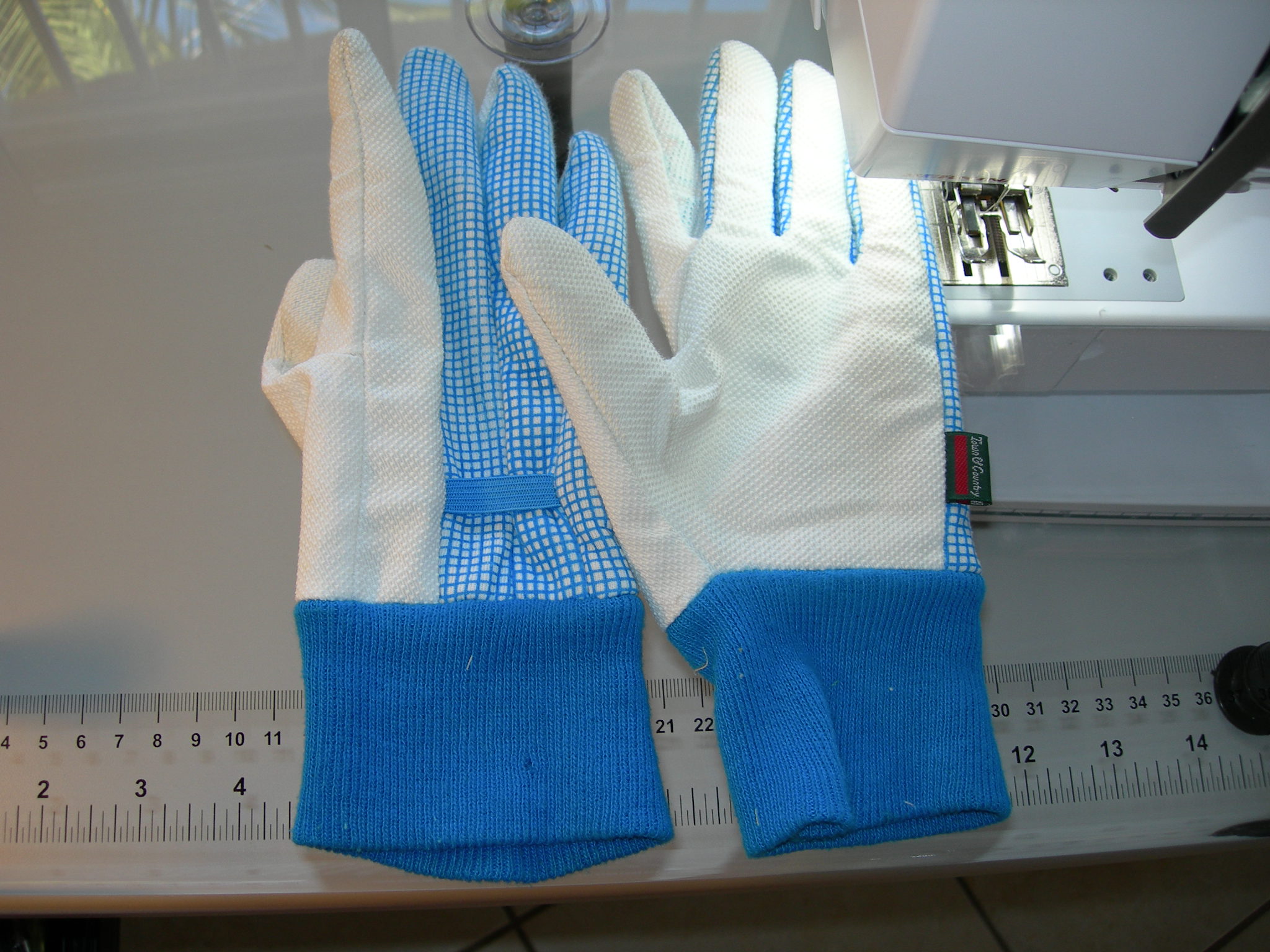
The sandwich is ready for quilting. Ordinary gloves from the garden center are a perfect help when moving the sandwich under the sewing machine.

I decided to quilt this piece with straight stitches following the vertical and horizontal seams. For machine quilting I use cotton thread :  Superior Thread King Tut 40/3 in Papyrus, walking foot and a stitch length of 3,5 mm on my Bernina.

Trim the extra backing and batting. The quilt is now ready for the last step : binding.

I found a good binding tutorial by Rita from Red Pepper Quilts.

You’ve made it – the quilt is now finished!

Hope you enjoyed this post. Please leave feedback and happy sewing, Barbora